Friday, October 28, 2011

Putting Your Pants On One Leg At A Time...

...is actually the hard way.  The assumption is that you are standing when you do so, which of course makes putting your pants on both legs at the same time virtually impossible.  But if you are sitting down, it is quite simple to pull your pants over both legs at the same time.  You don't have to go through as many contortions or worry about losing your balance.

Don't get me wrong, on the Long Ascent, it doesn't really matter which way you put your pants on, or even if you wear any pants at all.  What matters is challenging assumptions that make things more difficult than they need to be.

What are some of the assumptions that need to be challenged?
  • The way to go places is using a machine that weighs 10 times what you weigh.
  • Food is stored in the refrigerator.
  • You work out at the gym.
  • Doctors are responsible for your health.
  • If you need something, you buy it at the store.
  • A job is the best way to make a living.
The Long Ascent is difficult enough, we need to clear away any stumbling blocks we can.

Friday, October 21, 2011

A Matter of Perspective

How long is long?  It depends on who you ask.

When I read James Howard Kunstler's The Long Emergency, I practically breathed a sigh of relief.  Finally I had found someone who understood the dangers of fossil fuel depletion.  Since I had read Marion King Hubbert's work in the early 1980s, I felt like I was a lone voice in the wilderness trying to warn people.  At the time I shared Kuntstler's rather bleak view of the coming decades.

Many in the sustainability movement use the concept of the "seventh generation," a guideline that the Iroquois are reputed to have used.  At roughly 20 years per generation, that is 140 years in the future.

I have a great deal of respect for John Michael Greer.  His blog, The Archdruid Report, is one of the few things I anticipate reading each week.  I find myself agreeing with a great deal of what he says.  Where we differ is in a matter of perspective.  Like many others in the Peak Oil movement, he sees the future as a matter of decline.  Some of his most popular books are The Long Descent, The Eco-Technic Future, and The Wealth of Nature.  The future centuries he envisions are not as bad as most Peak Oil prophets imagine.

Marshall Savage had a broader perspective.  His masterwork, The Millennial Project: Colonizing the Galaxy in Eight Easy Steps, is a grand, sweeping vision of a bright future.  Regrettably, he actually starts the book at Step 2, with Step 1, the Foundation, as an epilogue.  It almost does seem like an afterthought, not having been as carefully thought out as the rest.  While the dream is still being kept alive by the Living Universe Foundation, little progress has been made.

The Long Now Foundation has one of the longest time horizons I have seen.  One of their concerns is the Y10K problem; they suggest everyone start writing the year with a leading zero, e.g. 02011.  Another project is the 10,000 Year Clock.  Their goal is to encourage long-term thinking.

Why does perspective matter?  My answer to that is taken from The Rules of Victory, a translation and commentary on Sun Tzu's The Art of War.  The best way to win is to "take whole", which in simplest terms could be described as getting your opponent to surrender without a fight.  (It actually is much more subtle than this; I highly recommend reading this book to fully understand the concept.)  As a rule, it is the person with the greater perspective who has the best chance of victory.

How long is long?  For my answer, take the chart of any "peak" which isn't necessarily dependent on a nonrenewable resource, for example, population, knowledge, energy usage, prosperity.  Shrink it down until it is just a small bump in a gently rising road, just large enough to be tripped over, where a human lifespan is just a point.

That is how long I mean when I say "The Long Ascent".

Friday, October 14, 2011

Half Ton People

Today I'd like to engage you in a thought experiment. Imagine you have just accepted a position at a facility for the morbidly obese. But this is no ordinary facility. The people who inhabit it have been here for generations. They have always been allowed to eat as much as they want for as long as anyone can remember. As a result everyone's weight is in the high triple digits. All the problems associated with such extreme weights, such as immobility, are considered a normal part of life.

Your task is to put these people on a diet. The facility can no longer afford to provide them with all they can eat. From now on they will only have a diet of 3000 calories. How will you break it to them?

Now, for most of us, a 3000 calorie diet is still excessive (athletes and Amish farmers being two notable exceptions), but from their perspective of being able to eat as much as they can, it is a terrible restriction.  One objection they are sure to raise is that they can't possibly maintain their current body weight with such little food.  Of course, they would be correct.  You would have to try to convince them that there are considerable advantages to weighing less, like being able to walk.  But they would counter that they get along fine without walking.  You may be able to convince a few of them to see past the experiences of their lifetimes and the lifetime of everyone they've personally known, but most of them would simply not do anything until they are forced to.

So, how do you tell someone who is used to consuming 20 barrels of oil a year that within a few decades they will have learn to get by on 2?

We need to answer that question to get people back on track on the Long Ascent.


Friday, October 7, 2011

Mammon's Curse

I doubt many outside of the Christian faith have heard of the concept of mammon. (For those readers not of the Christian faith, please bear with me. This is a critical concept in the Long Ascent, I am just developing it from my background.) Indeed, mammon is only mentioned twice in the Bible, in Luke 16 and Matthew 6, both saying you cannot serve God and mammon. Sometimes mammon is personified as a god, Mammon. Most Christians take mammon to be synonymous with money or greed. There is some justification for thinking that way; before the quote in Matthew 6:24, verses 19 through 21 talk about treasure, and in the next verse after the quote in Luke 16:13, it says how the Pharisees scoffed him, because they loved money.

There is a far deeper and more powerful interpretation of the god of Mammon, though, which is pointed to by what comes after Matthew 6:24, where Jesus talks about how God feeds the birds and clothes the lilies. This linkage suggests that Mammon is not the god of greed or money but rather is the god of material comforts. That is the concept of Mammon I am discussing.

This means that even when someone says, "I don't want to be rich, I just want to be comfortable,"
they are still serving Mammon. "What's wrong with that?," you may ask. Being comfortable seems very benign. Therein lies Mammon's treachery.

The first problem with serving Mammon is that our appetites tend to grow. If we are accustomed to chopped steak, that may give us comfort. If, however, we start eating sirloin and grow accustomed to that, chopped steak no longer gives us comfort. (Vegetarians, please pardon the example, I'm not familiar with your palate, please make your own substitution.) For those dedicated to seeking material comforts, this ratchet effect is very hard to reverse. Usually this only happens with a long period of deprivation, which is seldom voluntary. The best defense is to never let the ratcheting up happen in the first place. If you only have sirloin very infrequently, it is easier to be satisfied with the chopped steak.

The second problem with serving Mammon is the danger of overindulgence. This goes hand-in-hand with the first problem. In the material realm over-consumption virtually always has bad effects. Eating too much makes one obese and can lead to heart attacks and diabetes. Drinking too much alcohol can lead to cirrhosis of the liver or can even kill outright if consumed quickly. Even oxygen and water can kill in quantities that are too high.

The third part of Mammon's curse is definitely enhanced by the bad effects of overindulgence, but it applies to even the most moderate of people. All our bodies deteriorate with age. There is much we can do to slow the process down, but the process is programmed into the telomeres of our genes. Mammon doesn't have a retirement plan. Those who prize material comforts will find their bodies betraying them as they grow older and become less and less comfortable in their own skin. People who primarily value things other than material comfort can accept the changes in their bodies with much more equanimity.

These three parts of Mammon's curse are the most obvious, because they play out within the lifetime of any individual who serves Mammon. The fourth part is the most insidious and treacherous, because it plays out over the lifetime of any civilization where the majority seek material comfort. Every civilization ultimately has a limited resource base. Most start out so very small compared to their limits that they can act as if they have no limits. Indeed, traditionally the number of people has been the limiting factor in the wealth of a new civilization, so there is an incentive to grow. Even without that incentive, sexual pleasure is an appetite that Mammon's followers usually indulge. As more people are added, there comes a point where some resource becomes the limiting factor. A society that grows deliberately has the chance to see this coming and make adjustments. For a society that is primarily concerned with indulging material comfort, this point is rarely foreseen and even less likely to be avoided. This results in an overshoot which degrades the resource base and leads to a collapse.

This is Mammon's Curse. Not only does he destroy the lives of individuals who follow him, he eventually destroys entire civilizations. This fate can only be avoided by taking away his power and following an ideal other than material comfort. There are many ideals to follow, but each represents a path on the Long Ascent.

Friday, September 30, 2011

Hubbert's Mesa

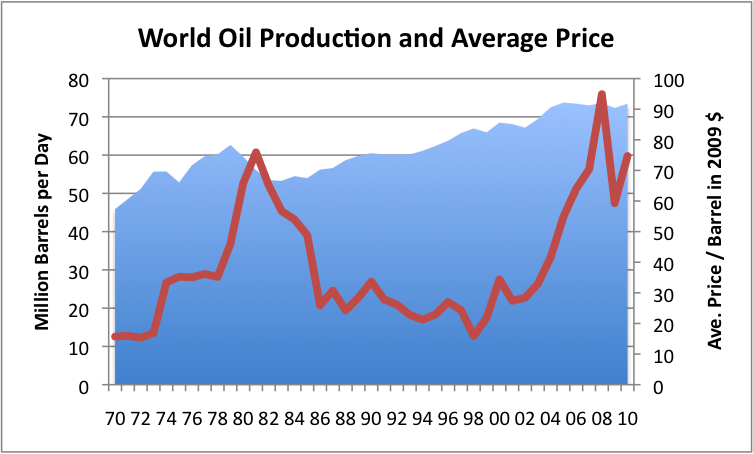
Much has been written about "Peak Oil" and the work of M. King Hubbert, sometimes referring to it as "Hubbert's Peak".  Using the term "peak" however is misleading.  Hubbert basically said that the extraction of a nonrenewable resource basically fit a bell curve.  If you take a close look at the top of a bell curve, you will see the slope at the absolute top is perfectly level, and the area around it is mostly level.

Real graphs do not follow the idealized graphs, however.  They have various ups and down, minor peaks and valleys.  Combining these with a relatively broad, flat expanse at the top, real graphs of resource usage look more like mesas than peaks.  If you look at a graph of world oil production, it looks like we entered the flat stage around the year 2000.

From World Oil Production - Looking for Clues as to What may be Ahead


Why this is important is because this allows petroholics to adjust to a stable oil supply.  Consequently they are in denial about the coming declines.  When the declines do come, especially the first few, they can be attributed to extraordinary circumstances, like a war, an uprising, or a natural disaster in a major oil exporting nation, like the Iranian revolution in 1979.  People come to expect that things will "get back to normal" afterwards -- and for the first couple times, they may be right.  And as the graph shows, the period from 1989 to 1993 was also relatively flat, due in large part to the collapse of the Soviet Union.  We can't be sure that we have truly past the peak until long after it happens.  But sooner or later the oil supply will finally dramatically and irreversibly drop off.  When it does, the majority of petroholics will have no clue what is happening and will be bewildered.

For those who are making the Long Ascent, however, it will be a welcome return to what has truly been normal for most of humanity for most of history.

Saturday, September 17, 2011

Petroholics Anonymous

Peak Oil has a very slippery slope.

Will there come a time when the oil production reaches an all-time high that will never be broken? Absolutely. It is almost necessarily so. Even if oil is created abiotically, we would have to not be using it faster than it is being created to make a difference. A century and a half of observing the behavior of individual wells precludes that possibility.

But, does that really matter?

To someone who is addicted to the ever increasing consumption of oil, of course it matters.

As with all addictions, most addicts have a hard time seeing beyond their addiction. Even for those that see how their addiction is hurting them, very few are able to overcome it on their own.

When the addict keeps needing more and more, though, there comes a point where they just can't get enough. When some clever heroin addicts reach this stage, they go to a methadone clinic to reset themselves. When some clever oil addicts reach this stage, they go camping or take a survival course.

Hi. My name is John Wheeler. I am a fossil fuel addict. I have been using for 45 years. I am using right now. The device I am using was made with and even has parts from fossil fuel, and it is powered by fossil fuel. I don't have all the answers, but I admit I have a problem. That is the first step on the Long Ascent.

Monday, September 12, 2011

What is the Long Ascent?

Imagine a world...

... where no one is fat;

... where everyone is fit;

... where no one dies of heart disease or diabetes;

... where everyone out of diapers has meaningful work;

... where no one wastes his or her time on mindless drivel;

... where everyone keeps learning for their entire life;

... where no one is very poor or very rich;

... where everyone has their basic material needs covered.

Some of these results will occur naturally.

Some of these will require a tremendous amount of effort.

Some of these will occur because the only alternative is extinction.

It will be a long, hard climb, but the sooner we start the Long Ascent, the faster we get there.

"The future promises us lives as humans were meant to live them — free, respected as persons, respected as peers, subject to none. It promises us a true community — something most of us have never really experienced. It promises a mind-boggling diversity of belief, tradition, culture and lifestyle." -- Jason Godesky, Thirty Theses